
I have discovered Steemit and it seems to be riddled with people claiming to be anarchists, but touting the wonders of free markets and how great capitalism is, otherwise known as anarcho-capitalists, or ancaps. According to Hogeye Bill: ”
Anarcho-capitalism is the political philosophy and theory which asserts that the State is an unnecessary evil and should be abolished, and a free-market private property economic system is morally permissible Part one is simply the definition of ‘anarchism,’ and part two is soft propertarianism, known more generally as ‘a free market’ or ‘laissez-faire.’ Let’s look more closely at each of the two parts of our definition. Moral permissibility is a “minimum” position. Almost all anarcho-capitalists believe also that a laissez-faire economic system is generally better than alternatives. Some strong propertarians, such as objectivists, go further and claim that laissez-faire is the only moral economic system.”
That the vast majority of anarchists reject the notion of “anarcho”-capitalism as a form of anarchism is an inconvenient fact for its supporters. Rather than address this, they generally point to the fact that some academics state that “anarcho”-capitalism is a form of anarchism and include it in their accounts of our movement and ideas. That some academics do this is true, but irrelevant. What counts is what anarchists think anarchism is. To place the opinions of academics above that of anarchists implies that anarchists know nothing about anarchism, that we do not really understand the ideas we advocate but academics do! Yet this is the implication. As such the near universal rejection of “anarcho”-capitalism as a form of anarchism within anarchist circles is significant. However, it could be argued that as a few anarchists (usually individualist ones, but not always) do admit “anarcho”-capitalism into our movement that this (very small) minority shows that the majority are “sectarian.” Again, this is not convincing as some individuals in any movement will hold positions which the majority reject and which are, sometimes, incompatible with the basic principles of the movement (Proudhon’s sexism and racism are obvious examples). Equally, given that anarchists and “anarcho”-capitalists have fundamentally different analyses and goals it is hardly “sectarian” to point this out (being “sectarian” in politics means prioritising differences and rivalries with politically close groups).
The “anarcho”-capitalist argument that it is a form of anarchism hinges on using the dictionary definition of “anarchism” and/or “anarchy.” They try to define anarchism as being “opposition to government,” and nothing else. Of course, many (if not most) dictionaries “define” anarchy as “chaos” or “disorder” but we never see “anarcho”-capitalists use those particular definitions! Moreover, and this should go without saying, dictionaries are hardly politically sophisticated and their definitions rarely reflect the wide range of ideas associated with political theories and their history. Thus the dictionary “definition” of anarchism will tend to ignore its consistent views on authority, exploitation, property and capitalism (ideas easily discovered if actual anarchist texts are read). And for this strategy to work, a lot of “inconvenient” history and ideas from all branches of anarchism must be ignored. From individualists like Tucker to communists like Kropotkin and considered anarchism as part of the wider socialist movement. Therefore “anarcho”-capitalists are not anarchists in the same sense that rain is not dry.
Significantly, the inventor of the term “anarcho”-capitalism, Murray Rothbard had no impact on the anarchist movement even in North America. His influence, unsurprisingly, was limited to the right, particularly in so-called “libertarian” circles. The same can be said of “anarcho”-capitalism in general. This can be seen from the way Rothbard is mentioned in Paul Nursey-Bray’s bibliography on anarchist thinkers. This is an academic book, a reference for libraries. Rothbard is featured, but the context is very suggestive. The book includes Rothbard in a section titled “On the Margins of Anarchist Theory.” His introduction to the Rothbard section is worth quoting:
“Either the inclusion or the omission of Rothbard as an anarchist is likely, in one quarter or another, to be viewed as contentious. Here, his Anarcho-Capitalism is treated as marginal, since, while there are linkages with the tradition of individualist anarchism, there is a dislocation between the mutualism and communitarianism of that tradition and the free market theory, deriving from Ludwig von Mises and Friedrich von Hayek, that underpins Rothbard’s political philosophy, and places him in the modern Libertarian tradition.” [Anarchist Thinkers and Thought, p. 133]
This is important, for while Rothbard (like other “anarcho”-capitalists) appropriatessome aspects of individualist anarchism he does so in a highly selective manner and places what he does take into an utterly different social environment and political tradition. So while there are similarities between both systems, there are important differences along with the anti-capitalist nature of individualist anarchism (i.e. those essential bits which Rothbard and his followers ignore or dismiss). Needless to say, Nursey-Bray does not include “anarcho”-capitalism in his discussion of anarchist schools of thought in the bibliography’s introduction.
Of course, we cannot stop the “anarcho”-capitalists using the words “anarcho”, “anarchism” and “anarchy” to describe their ideas. The democracies of the west could not stop the Chinese Stalinist state calling itself the People’s Republic of China. Nor could the social democrats stop the fascists in Germany calling themselves “National Socialists”. Nor could the Italian anarcho-syndicalists stop the fascists using the expression “National Syndicalism”. This does not mean their names reflected their content — China is a dictatorship, not a democracy; the Nazi’s were not socialists (capitalists made fortunes in Nazi Germany because it crushed the labour movement); and the Italian fascist state had nothing in common with anarcho-syndicalist ideas of decentralised, “from the bottom up” unions and the abolition of the state and capitalism.
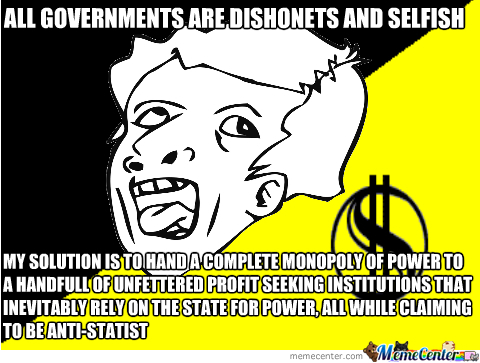
As we know, especially indicated by Mylan’s recent exploitation of those needing medical supplies, capitalism has rulers, is exploitative, and does not honor autonomy nor solidarity, and therefore “anarcho-capitalism” is an oxymoron and a false idea.
i prefer no rulers, and to operate in a shared or gift economic system (if it can be called a system).

 Gene's Community Ramblings
You must be logged in to post a comment.